Hi there! Today I am going to analyze Adobe ($ADBE), a company that I have at an average price of $265 and that is now trading at $235.5 (-11.14%). Business moat: Adobe is the leader in creative software. It built a whole industry around the PDF standard and many of its products are used every day to generate images and videos. The company made a successful transition from perpetual licenses to SaaS subscriptions in 2014, showing the dominant position it had. Of course, recently there is a lot of fear due to AI disruption, so let’s see what we can get from the numbers. Financials (Sources: Finviz, GuruFocus and StockAnalysis): Annualized revenue growth: - 5 years: 13.06% - 3 years: 10.89% - 1 year: 12.03% - Guidance 2026: 11.8 - 12% ($26.576 billion to $26.626 billion), source: Adobe Q3 2026 Results, September 10, 2026. Annualized FCF/share growth: - 5 years: 13.10% - 3 years: 13.70% - 1 year (TTM): 17.67% (without considering share repurchases → FCF growth: 10.35%) P/FCF = 8.65 (FCF yield = 11.56%) SBC is 19.55% of FCF. Adjusted FCF yield after SBC: 9.30% We can see that Adobe is growing, for now, at the same pace as in previous years, so in terms of growth I see little impact from AI. In addition, the FCF yield after SBC is quite interesting. In terms of profitability ratios, we can see that gross margin and operating margin are quite stable, while ROIC has improved in recent years... ...Read the full article for free here. You can also subscribe for free to have new articles delivered straight to your inbox. https://theethicalridgetribe.substack.com/p/adobe-adbe-investment-thesis Disclaimer: For educational and informational purposes only. Nothing here constitutes investment advice. The author holds a long position in the security mentioned. Do your own due diligence.read more
Booking Holdings has fallen 23.5% this year. Airbnb is up 16.0%. Marriott is up 13.5%, Hilton 9.3%, the S&P 500 13.1%. Expedia, which is the closest thing Booking has to a twin, is down only 6.8%. That spread is the whole puzzle. If people had stopped travelling, Marriott and Hilton would not be up. If AI agents were eating the booking funnel, Airbnb would not be up 16% and Expedia would not be outperforming Booking by seventeen points. Something is happening to this specific company that is not happening to the industry around it. The popular explanation is that AI is coming for the online travel agency and Booking is the biggest one, so Booking gets hurt the most. I spent this week going through ten years of filings, the last twelve quarterly prints, the May 2026 bond prospectuses and a pile of earnings call transcripts, and I do not think that is right. Or rather, it is a third right, and the two thirds that nobody talks about are more interesting. Here is the short version. Booking spent seven years converting itself from an agency business into a payments business. That conversion cost it 650 basis points of margin, delivered a lower take rate than it started with, and bought it one thing of real value: a $10.1 billion pile of customer cash that funds the buyback. The conversion is now essentially finished, which means the margin cost is permanent and the cash windfall is done growing. And that happened to finish at exactly the moment the AI narrative arrived. The market is pricing a story about robots. The number that actually broke is the margin guide, and it broke twice this year. Whether you should own it anyway is a separate question, and this deep dive will help you to get there. Read the full deep dive here: https://cycledesk.substack.com/p/booking-holdings-bkng-travel-is-not?r=7unzzg&utm_campaign=post&utm_medium=web&showWelcomeOnShare=trueread more
Rise & Grind. 🌄 Friday closed green: S&P +0.51% to 7,743, Dow +0.93% to 51,829, Nasdaq +0.5% to 27,069, TSX +0.26% to 35,801. Monday opens red, with S&P futures -0.5%, Nasdaq futures -1% and TSX futures -0.5% as WTI jumps 4% to ~$96 and the 10-yr tops 5.2%. $NVDA trades +1.2% premarket after adding $150B to its buyback, now $235B total. Happy Hunting today! 🫡
Excited to share I officially brought in over $100k in returns alone this year and we aren’t even done with 2026 yet, not even freaking close… New GOAL: $125k Let’s go, get ready for a new week. Lock the heck in… I’ve been posting all of my trades immediately on Instagram stories until the Vanguard connection is fully fixed. If you want in on the trades and where I’m at in the world 🇹🇭 for now, follow along if you want: https://www.instagram.com/ari.gutman?stkn=MTZlYW1ldjNqaHM2bA%3D%3D&utm_source=qr Happy investing to all!
If someone gave you $1,000 today, what would you actually do with it? I’ve been thinking about this a lot lately. Would you put all of it into an ETF? Buy a few stocks? Put some into Bitcoin? Or honestly just keep it in your savings account? As a college student, $1,000 feels like a pretty big amount of money. And when I first started investing, I definitely overcomplicated things and spent way too much time worrying about finding the “right” stock. So I made a video breaking down how I would approach $1,000 today, including what I’d do first, how I’d use my TFSA, ETFs vs individual stocks, diversification, and the approach I’d personally take. It’s not financial advice. I’m just sharing what I’ve learned from starting my own investing journey at 18. If you had $1,000 to invest today, what would you do with it? I’d actually be really interested to hear what other people here would do. https://youtu.be/3SN1dkPq4gU?si=JQveoeH4JAPN_2iF #Investing #PersonalFinance #TFSA #StudentInvestingread more
SoFi was just named the Best Overall Online Bank in Money’s 2026–2027 Readers’ Choice Awards. More than 1,000 readers voted across 35 financial categories, and $SOFI I came out on top for online banking. Another sign the brand is getting stronger while the business keeps scaling.
I just updated my stock watchlist. 10 companies I’m actively researching right now. Some I want cheaper. Some still need to prove more. And a few are starting to get REALLY interesting. Here’s the full list: McDonald’s | $MCD McDonald’s is the newest addition, and the valuation is finally getting interesting enough for me to start digging much deeper. AppLovin | $APP The growth and execution are hard to ignore, but I’m still trying to figure out how much of that upside is already priced in. MercadoLibre | $MELI I love the combination of ecommerce and fintech, and this is one I’d be very interested in owning at the right valuation. Nike | $NKE Nike is becoming a really interesting turnaround setup if the brand can translate its global strength back into better growth. Visa | $V Visa is exactly the type of high-quality compounder I’d like more of in my portfolio if the price gets attractive enough. CoreWeave | $CRWV CoreWeave gives me direct exposure to the AI infrastructure buildout, but the capital intensity and valuation mean I’m taking my time. Duolingo | $DUOL Duolingo has built one of the strongest consumer brands in education, and the pullback has made me much more interested in the stock. Mastercard | $MA Mastercard is another business where I have almost no issue with the company itself, so most of my focus is simply on valuation. Wingstop | $WING Wingstop has an incredibly interesting franchise growth story, but I want the valuation to give me a much better margin of safety. Palantir | $PLTR Palantir’s execution has been incredibly strong, but valuation is still the biggest thing keeping me on the sidelines read more
$NOW keeps adding more pieces to the enterprise AI stack. ServiceNow is partnering with Reco to expand security around AI agents inside the Now Platform. Reco is bringing 170+ ServiceNow-specific posture checks and can route security findings directly back into ServiceNow workflows for remediation. As enterprises deploy more AI agents, security and governance become a much bigger part of the stack. Another small piece of the “ServiceNow as the control layer for enterprise AI” thesis.
I'm buying all the Latin names today (Cerebras is quasi-Latin, but close enough). Today I bought more shares of $NVTS and drastically lowered my average cost on $CBRS. Anytime it dips below $195, that's a buy for me. Thinking about throwing some money into $DRAM
Good morning and a very happy Monday ☕️🌧️ Coming to the end of a month long business trip around and across the US. It’s been a great trip, great people, and a chance to step away from the screens for a bit and enjoy the experience. Now it's back to reality. The market has pulled back, there's a lot happening beneath the surface, and it's worth taking a step back to look at the bigger picture before we start talking charts and setups. Don't Lose Sight of the End Goal At the end of the day, none of us are doing this just to stare at stock prices all day. We're investing, trading, and building portfolios to create options for ourselves. Financial freedom isn't about having the biggest account balance. It's about having control over your time, reducing stress, and creating opportunities for yourself and the people around you. It's easy to get caught up in daily market moves and portfolio fluctuations, but don't forget to enjoy the life you're working so hard to build. Take a moment to appreciate how far you've come and trust the process. Geopolitics, Oil, and the Macro Picture: From a macro perspective, geopolitical tensions in the Middle East continue to create uncertainty, particularly in energy markets. We're seeing ongoing supply chain challenges, airspace disruptions, and shifts in global trade routes. As a result, oil has pushed back above $94 per barrel and continues to trend higher, making a series of higher highs and higher lows. The reality is simple: when oil moves from the mid $50 range toward $100+, inflation becomes much harder to control. Energy costs eventually find their way into almost every corner of the economy, and that's something both the market and the Fed need to pay attention to. Key Data to Watch This Week: This week's economic calendar is packed with reports that could have a meaningful impact on market direction. JOLTS Job Openings: One metric I'm watching closely is the ratio of unemployed workers to available jobs. If that number falls below 1.0, it would suggest the labour market is beginning to cool, which would support the case for the Fed to remain on pause or eventually consider cuts. If it stays elevated around 1.1 to 1.2 while inflation remains stubborn, markets will likely begin pricing in additional tightening. PCE Inflation Data: This remains the Fed's preferred inflation measure and could be one of the most important reports of the week. The market wants evidence that inflation is moving in the right direction. If that progress stalls, expect volatility. ADP & Non-Farm Payrolls: Friday's jobs report will be another major catalyst. Current expectations are centred around unemployment holding near 4.2%. As always, it's less about the headline number and more about what it says regarding the overall health of the labour market. Rates Still Matter: One thing investors continue to underestimate is how long restrictive monetary policy can stay in place. Historically, Fed tightening cycles rarely stop after a single move. Most have lasted considerably longer and required markets to absorb multiple rounds of higher rates. I'm not suggesting we're heading back to a 1970s style inflation environment, but if inflation proves sticky, it's not unreasonable to think policy rates could move another 125 to 150 basis points higher before this cycle is over. At the same time, fixed income is becoming increasingly competitive. 10-Year Treasury Yield: above 5.2% 30-Year Treasury Yield: above 5.5% When investors can earn over 5% in government bonds with significantly less risk, equities need to work harder to justify current valuations. With the S&P 500 earnings yield sitting around 4.5%, the equity risk premium remains under pressure. Either earnings need to grow meaningfully from here, valuations need to compress, or some combination of both. What History Tells Us: Looking at past market cycles, non-recessionary bear markets tend to see pullbacks in the 20% to 23% range over roughly six to seven months before the longer-term uptrend resumes. Recessionary bear markets are a different story altogether, typically lasting longer and producing much deeper drawdowns. As we move through Q4, seasonality is also worth keeping in mind. Election cycles have historically created volatility through September and October. Once uncertainty clears, markets have often delivered stronger performance in the months that follow. History doesn't predict the future, but it does provide useful context. Bottom Line: Major indices are pulling back from recent highs, and a lot of the leadership names like Nvidia and Tesla are simply digesting significant moves. This isn't a time to get emotional. Focus on managing cash flow, remain patient with new entries, and continue allocating capital with a plan rather than reacting to headlines. Stay disciplined, manage risk, and keep playing the long game. We'll see what the data gives us this week and adjust accordingly. Happy investing 🫶🏽read more
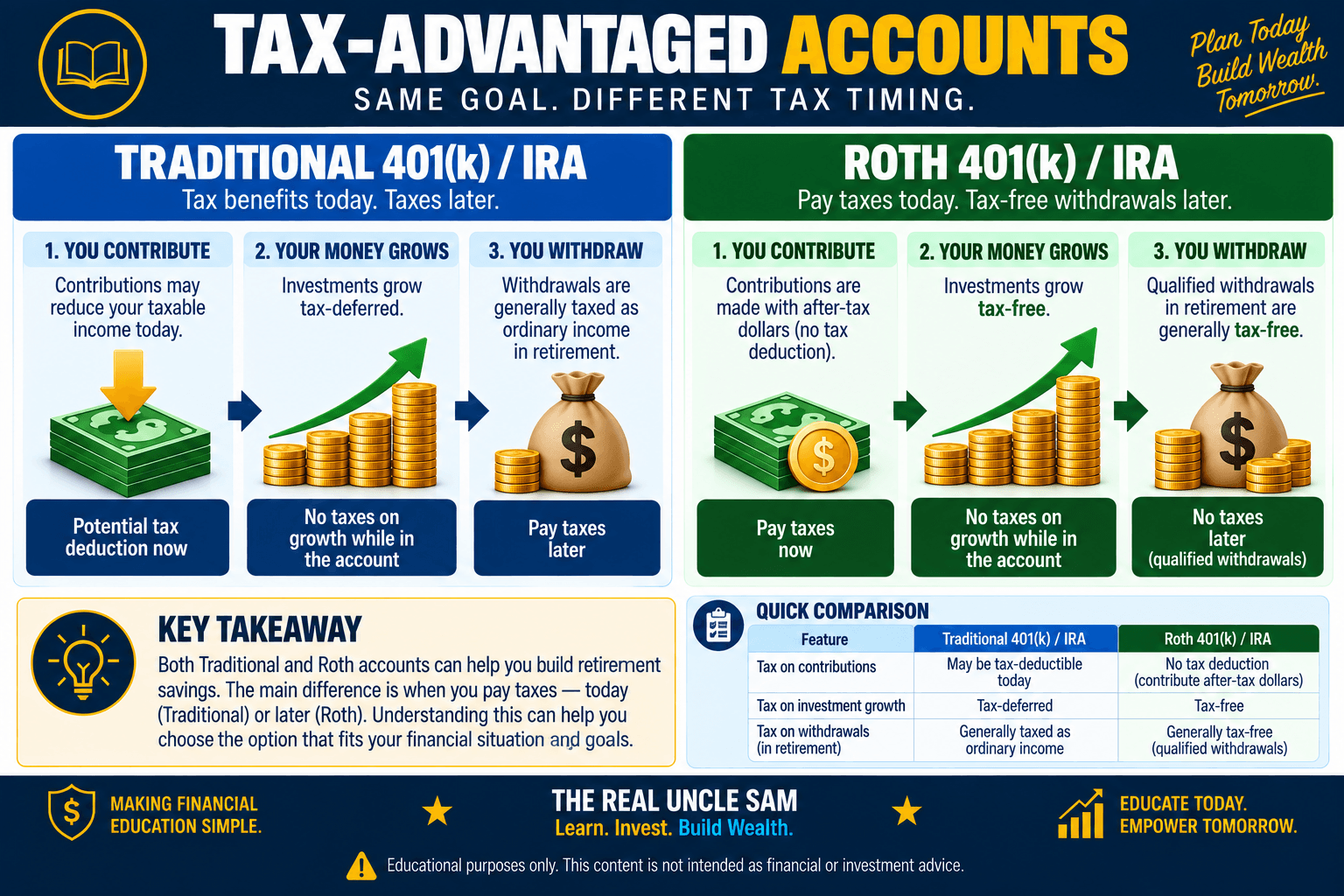
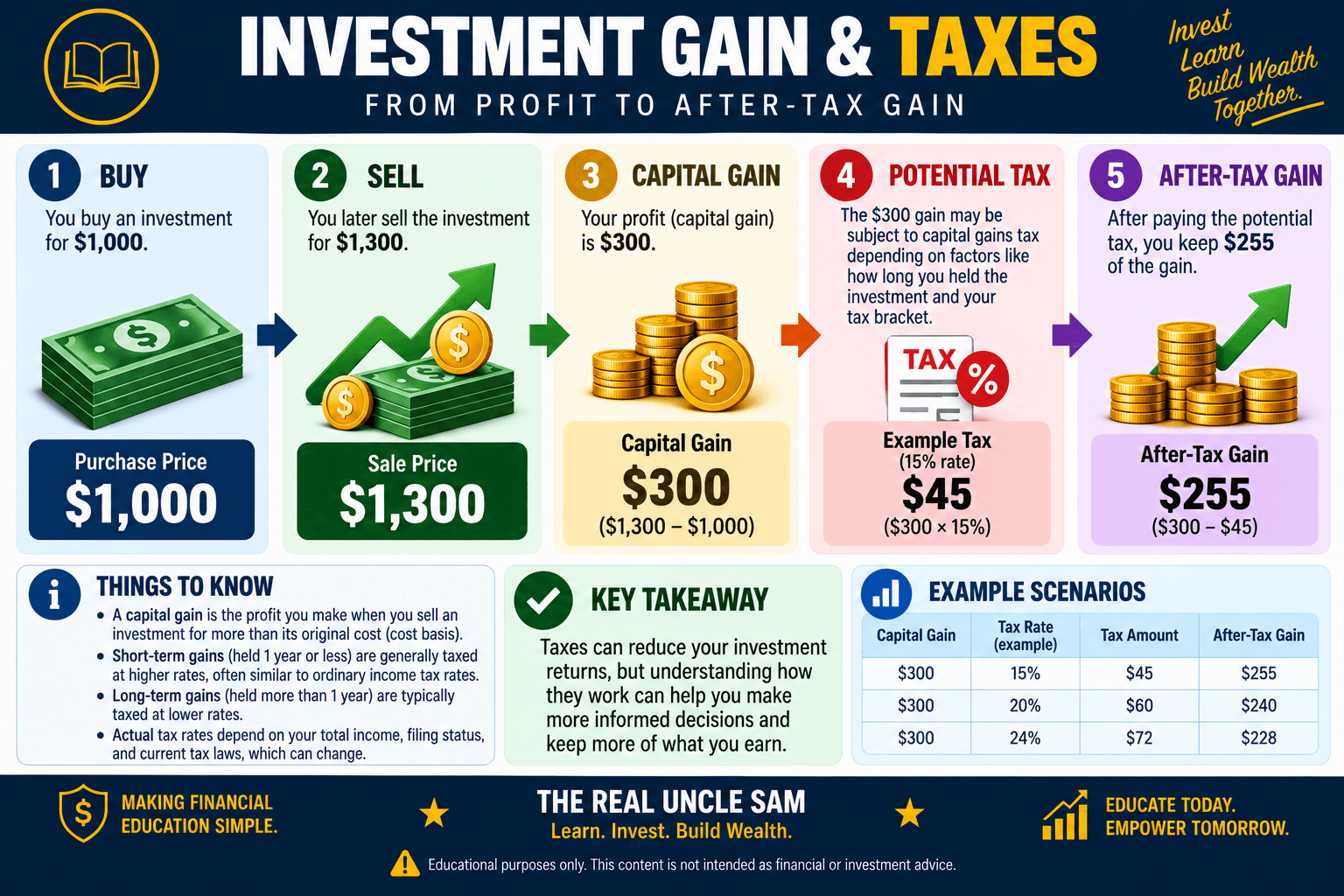
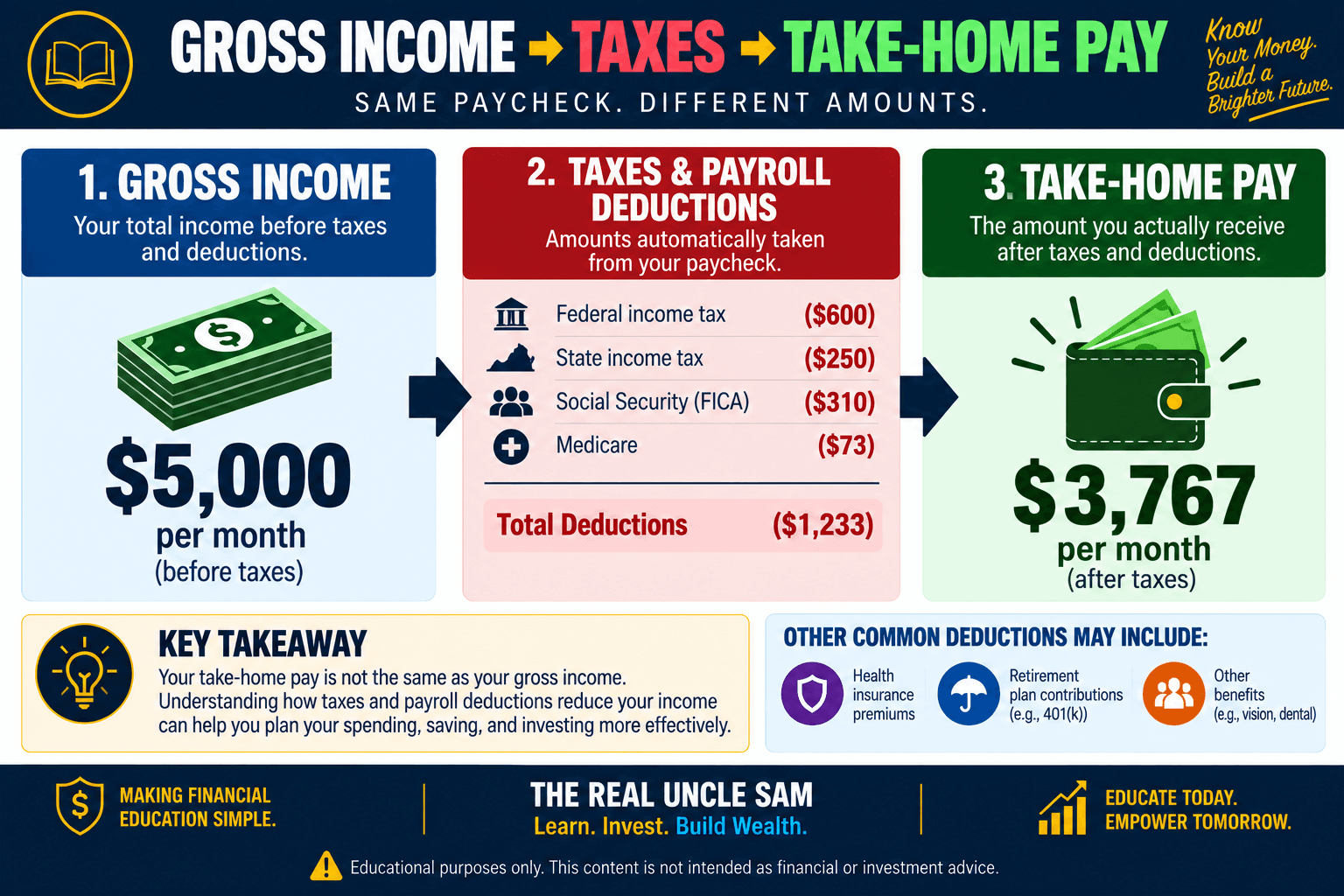
🧾 How Taxes Affect Your Wealth Taxes affect more than your paycheck. They can also influence how much of your income and investment returns you ultimately keep and can use toward building wealth. Suppose you earn $5,000 per month before taxes. Your gross income is $5,000, but that isn't necessarily the amount available for spending, saving, or investing. Income taxes and payroll taxes can reduce your take-home pay. Taxes can also affect investments. For example, when an investment is sold for more than its purchase price, the profit may be a capital gain and could be subject to tax. Dividends and interest income may also be taxable, depending on the investment and account. This makes tax-efficient financial planning an important part of long-term wealth building. Certain accounts, such as 401(k)s and IRAs, may provide tax advantages, although the rules differ by account type. Some may provide tax benefits today, while others can provide tax advantages later. Taxes shouldn't be the only reason you make a financial decision. Investment quality, risk, diversification, time horizon, fees, and your financial goals still matter. The important lesson is simple: It's not only how much you earn or how much your investments grow. It's also how much you ultimately keep after taxes and other costs. Understanding basic taxation can help you make more informed decisions about earning, saving, investing, and planning for the future. ✅ Key Takeaway Building wealth isn't only about increasing income and investment returns. It's also about understanding the impact of taxes on the money you keep. Learn the basic tax treatment of your income, investments, and financial accounts so you can plan more effectively. 📖 Financial Term of the Week Capital Gain: The profit that results when you sell an asset for more than its cost basis. Example: If you buy an investment for $1,000 and later sell it for $1,300, your capital gain is $300 before considering applicable adjustments, fees, or taxes. ❓ Question for the Community Before learning about personal finance, did you think more about how much you earned or how much you actually kept after taxes and other costs? 📚 Follow this page for a new financial education lesson every week as we learn, invest, and build wealth together. ⚠️ Educational purposes only. This content is not intended as financial or investment advice. The Real Uncle Sam Making Financial Education Simple. Learn. Invest. Build Wealth.read more
In a narrow tape, the temptation is to chase the few names that are working. My rule is the opposite. A narrow tape means most breakouts have no company. A name that runs 13% in a week with its weekly clock still pointing down isn't leading. It's alone, and alone doesn't hold. So my list gets shorter, my stops get tighter, and cash at 5% stays a position, not a failure. The market will widen out or it won't. I don't need to guess which. I need to still be here when it does 🐝 Check my #TradingToday Guide, link in bio 🔗 🐝
My best AI investment wasn’t an AI stock. It was an energy company. I bought $BE at an average price of $21.78. Today, I’m up over 1,200%, turning an initial ~$3,000 investment into over $40,000 🤯 But the funny thing is, I didn’t originally buy Bloom because of AI. I invested because I found Bloom Energy’s approach to power really interesting. Then the AI boom took off, and something became increasingly obvious: AI has a massive energy problem. Everyone talks about $NVDA and GPUs. But those GPUs have to sit inside data centres consuming enormous amounts of electricity. And getting enough power to those data centres is becoming a bottleneck. That’s where Bloom became really interesting. Bloom’s fuel cells can generate electricity onsite, giving data centres another way to secure power without relying entirely on waiting for additional grid capacity. As AI infrastructure spending exploded, Bloom increasingly became part of that buildout. And watching the thesis evolve taught me one of my favourite investing lessons: Don’t just ask who wins a trend. Ask what every winner needs. AI needs chips. Chips need data centres. Data centres need power. Sometimes the most interesting opportunity isn’t the company everyone is talking about. It’s the company one layer underneath it. Obviously, being up 1,200% doesn’t mean $BE will keep going up. Having a position appreciate this much creates a whole new set of decisions around valuation, concentration, and when to trim. But regardless of where $BE goes from here, this investment changed one of the biggest questions I ask when looking at a trend: What does every winner need?read more
Tesla just put paid Cybercab rides on the road in Austin. No steering wheel. No pedals. No driver. 👀 And the AI chief says 24 hour robotaxi service starts next month. A 10x more powerful self driving brain is coming. But car sales fell two years in a row. And Waymo is sitting on 200 million driverless miles. So which story are you buying? I am long $TSLA because I think the robots win. 🚀 The whole race runs on $NVDA chips & Musk is buying them by the truckload. Bear case is real though. 200 million miles is a big head start. $GOOGL is not messing around. Where do you stand? Car company in trouble or robot company of the future? 👀read more
HAPPY MONDAY! Went ahead and bought more $AMZN and $SOFI today 📈 I’m thinking LONG TERM with both of these companies. $AMZN: • E-commerce powerhouse • AWS + AI exposure • Advertising business continues to grow • Huge long-term opportunity $SOFI: • Building a full financial ecosystem • Growing products + members • Strong fintech/technology angle • Lots of room to grow long term Not worried about where either stock is tomorrow. I’m investing in where I think these businesses can be 5–10+ years from now. 🚀read more