Currently at college waiting for my next class to start (Consumer Behaviour) and was thinking about everything i've learned and done little over my first year investing in the market. Accomplished⭐ -$20,000 invested at 22. -Build a 5-6 Month Emergency fund. -Invested every paycheck no matter what. -Made some great connects on this platform. Learned👨🎓 -Consistency beats everything. -Use the KISS Strategy to your portfolio. -Credit Cards are a powerful tool (use them). -Stay Diversified. -It's ok to splurge on yourself once in a while, enjoy life. What are you proud of on your investing Journey Because you should be⏬⏬ Cheers. Enjoy the week.👋read more
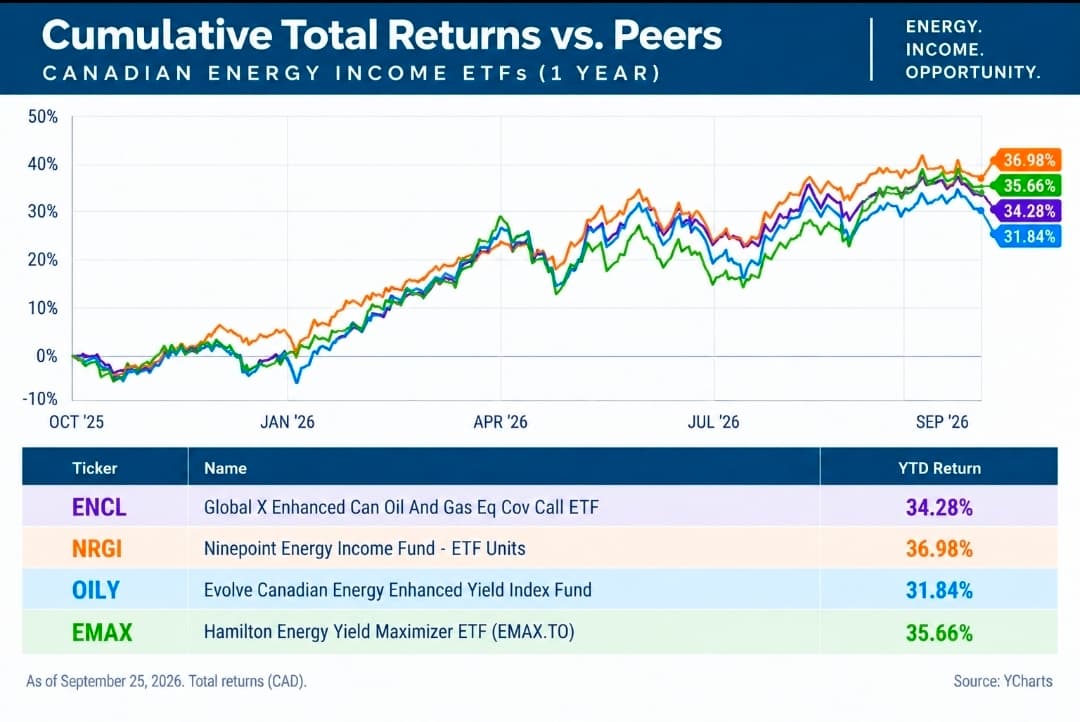
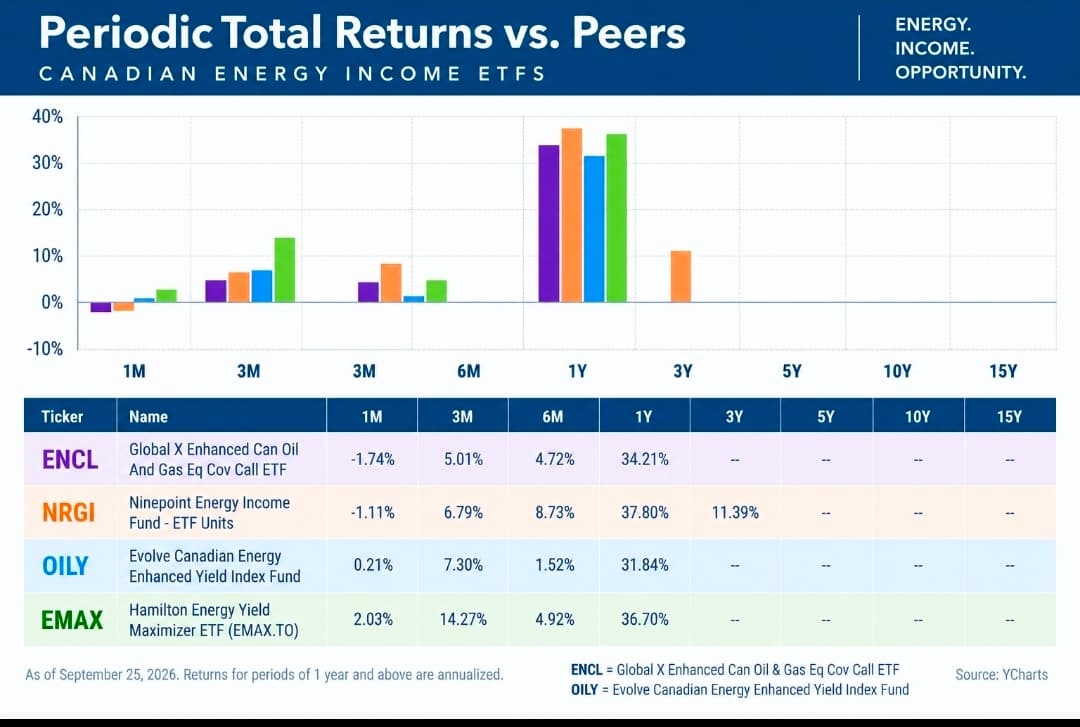
Over the last year, NRGI leads the Canadian energy income peer group with a +36.98% total return, followed closely by EMAX (+35.66%), ENCL (+34.28%), and OILY (+31.84%) as of September 25, 2026. The relatively tight spread shows that underlying Canadian energy exposure remains the dominant return driver, while leverage, option overlays, and portfolio construction create the differences between strategies. Shorter-term leadership has rotated. Over the last 6 months, NRGI (+8.73%) leads, followed by EMAX (+4.92%), ENCL (+4.72%), and OILY (+1.52%). Over 3 months, EMAX (+14.27%) leads, ahead of OILY (+7.30%), NRGI (+6.79%), and ENCL (+5.01%). Over the last 1 month, EMAX (+2.03%) and OILY (+0.21%) were positive, while NRGI (-1.11%) and ENCL (-1.74%) declined modestly.
I ran a 6-month hypothetical scenario assuming the S&P 500 rises 5%. Based on each ETF’s measured historical sensitivity: 🟢 HEQT: $24.62 → $25.77 (+4.7%) 🟢 XEQT: $45.97 → $48.01 (+4.4%) The interesting part? HEQT showed slightly higher sensitivity to S&P 500 movements — 0.94x vs 0.89x for XEQT. ⚠️ These are not price predictions. They’re scenario estimates based on historical relationships, and they exclude distributions.read more
Pursuant to my last post, I’ve sold out of VEQT/VXC/VCN and deployed the first tranche of my portfolio into CAGX. Although I have known about factor investing for a number of years now, I’ve done a thorough literature review of the latest academic and empirical evidence as part of my due diligence, for a final evaluation before pulling the trigger. Based on the evidence, there’s a pretty solid case to be made for moderate factor tilts toward Avantis’ strategy of cash based operating profitablity, adjusted book value and size, especially integrating them in a multi-factor manner. One could reasonably expect: 1. Factor premia of 50-100 basis points before fees and other costs, which is meaningful. 2. Factor diversification/reliability of returns as each factor has different correlations with each other and market beta. 3. Good middle ground of tilting away from richly valued/overconcentrated AI megacaps and AI ecosystem stocks to cheaper/more profitable/smaller stocks, without actually omitting the AI winners completely. Kind of like have your cake but eat half of it. There are downsides obviously, such as factor premia not showing up for extended periods of time, factor premia decay/disappearance, and tracking error. However the fund fees are low enough compared to Vanguard/Blackrock/BMO total market funds that this bet seems worth taking - the MER/FER spread is about 12 basis points give or take.read more
🌍 What Happened This Week 🔹 It was a week defined by a few big storylines rather than one broad move. The AI trade kept running, with a leading chipmaker crossing $1 trillion in market value on booming data center demand from major cloud and AI players, and a large social media company's new AI product launch adding fresh fuel to sentiment across the group. Biotech had its own moment, headlined by one of the sector's sharpest rallies in years after a closely watched cancer-vaccine trial read out well. Governance drama and some profit-taking crept in by week's end, as a high-flying chip designer gave back gains on insider selling and a fight over an outsized executive pay package, a reminder that even this year's biggest winners can have rough days. Energy was the clear underperformer as crude prices slid, dragging down anything tied to oil and pipelines, while easing bond yields gave the broader risk rally a tailwind. ━━━━━━━━━━━━━━━━━━━ 📈 Market Returns (YTD): 🇺🇸 S&P 500: +14.02% 🇺🇸 Nasdaq-100: +21.62% 🇨🇦 S&P/TSX 60: +14.81% 🌍 MSCI EAFE: +13.24% ━━━━━━━━━━━━━━━━━━━ 🛡️ Covered Call Basket ETFs: 🔹 $QMAX (+5.7%) and $QQCL (+4.7%) led the basket this week as tech-tilted covered call strategies caught the AI and semiconductor bid, followed closely by $YMAG (+4.6%) and $QQQY (+4.5%). $HBIX (+4.6%) also bounced along with bitcoin, and $HHIS (+3.9%) rounded out the top movers. 🔹 On the softer side, $HBTE and $HDIV were essentially flat this week, both down about 0.2%. On the year, $SIXY (+30.0%) and $QQCL (+26.4%) lead the group, while $BIGY and $HBIX remain the two outliers with negative YTD returns: $BIGY is down 2.5% YTD, and $HBIX is down 6.9% YTD and still 28.7% over the trailing year, by far the deepest hole in the basket despite this week's bounce. ━━━━━━━━━━━━━━━━━━━ 💻 Single-Stock Covered Call ETFs: 🔹 $YAMD and $AMDY , both tracking AMD, jumped 13.2% and 10.1% this week and are now up a staggering 181.7% and 191.1% YTD respectively. $INHI (Intel) added 15.5%, $YMET and $METE (Meta) rose 14.9% and 12.5%, and $CRWY (CrowdStrike) gained 6.8% as chip and software names led the tape. 🔹 $SHHI , $SHPY , and $SHPE , all tracking Shopify, jumped 11-14% this week but remain down 12-17% YTD, a reminder of how far they fell earlier in the year. The Palantir group ($PLHI , $PLTE , $YPLT ) added 7-8.5% and sits modestly positive on the year. 🔹 On the softer side, $KGHI (Kinross) and $NOVY (Novo Nordisk) were the week's worst performers, down 11.6% and 10.4%, and $ORCY (Oracle) fell 6.5%. Canadian energy and pipelines broadly cooled: the CNQ group ($CNQY , $CQHI , $CNQE ) and Enbridge group ($ENBY, $ENHI, $ENBE) each fell 3-4% even though most remain up sharply for the year. $TY and $TEHE (Telus) are the ones to watch: both fell again this week and remain down roughly 34% YTD and 46% over the trailing year, the deepest hole in this section. ━━━━━━━━━━━━━━━━━━━ 🎯 YieldMAX ETFs: 🔹 $MRNY (Moderna) was the standout by a wide margin, surging 23.3% this week and now up more than 400% YTD. $AMDY (AMD) added 11.0% and is up 135.9% YTD, while $FBY (Meta) rose 10.1%, and semiconductor-focused $SOXY and $CHPY gained 7.0% and 6.2%, both up more than 70% YTD. 🔹 $MARO (Marathon Digital) was the week's weakest performer, down 3.9%, and $YQQQ and $WNTR , both short-strategy funds, fell 2.9% and 2.3% as their reference names (the Nasdaq-100 and MicroStrategy) worked against them, the exact move these funds are built to lose on. $GDXY (gold miners) also cooled, down 2.2%. YTD range: $MRNY (+411.7%) on top; $RBLY (-45.9%) at the bottom. ━━━━━━━━━━━━━━━━━━━ ⏱️ 0DTE ETFs: 🔹 $QDAY led again this week, up 4.6% and now +36.8% YTD, while $QQQY (Defiance Nasdaq-100) and $QDTE (Roundhill Innovation-100) added 3.0% and 2.1% on continued tech strength. 🔹 On the softer side, $CDAY , $RDTE , and $IWMY were the only funds in the group to slip this week, down 0.2-0.8%. $IWMY (small-cap exposure) is also the group's YTD laggard at +9.0%, well behind the rest of the pack which is mostly up in the mid-to-high teens. ━━━━━━━━━━━━━━━━━━━ 💰 Cash-Covered Puts ETFs: 🔹 $HMYY (Hims & Hers) led with a 2.5% weekly gain even though the fund remains down 42.2% YTD, the deepest YTD hole in this category. $IOYY (IonQ) and $SMYY (Super Micro) also gained, up 1.8% and 1.5%. $AMYY (AMD) and $SEMY (Super Micro) stand out as the biggest YTD gainers in the group, up 13.1% and 36.1%, while broad-index put-writers $TQQY and $YSPY (tracking QQQ and SPY) are also modestly positive, up 7.2% and 7.0%, benefiting from steadier gains in their underlying benchmarks. 🔹 $MAAY (Marathon Digital) and $RTYY (Riot Platforms) were the weakest, down 1.3% and 1.2%, both still deeply negative on a YTD basis as crypto-mining names remain under pressure. ━━━━━━━━━━━━━━━━━━━ 📅 Weekly Distribution ETFs: 🔹 $METW , $AMDW , and $ARMW were the standout performers, up 15.4%, 14.9%, and 14.7% respectively, with $AMDW and $ARMW now sitting on extraordinary YTD gains of 240.1% and 216.6%. $PLTW (Palantir) added 8.0% and $MSFW (Microsoft) rose 5.4%. 🔹 On the softer side, $BABW (Alibaba) and $GDXW (gold miners) led the losers, down 3.8% and 3.3%, with $TSYW (Treasury bonds) and $GLDW (gold) also falling 2-3% as gold gave back some of its recent gains. $GOOW (Alphabet) and $AMZW (Amazon) each slipped about 2% despite both being solidly positive for the year. 🔹 On the year, $AMDW (+240.1%) and $ARMW (+216.6%) remain the runaway leaders, while $BABW (-31.7%) sits at the bottom after a rough year for the stock. ━━━━━━━━━━━━━━━━━━━ https://docs.google.com/spreadsheets/d/1YooRlFl3jibMoMiDJuXrTzai7jiHG8jCOsX-q_Bdhfs/edit?usp=sharingread more
“Aggregation of marginal gains.” Love this concept. The idea of “the aggregation of marginal gains” is a mindset that has helped me tremendously. A lot of the acts that lead to having a significant amount of wealth at a young age are downright boring, stale and unattractive. It’s uncool to be frugal, to sacrifice or to delay gratification; particularly in your 20s. That’s probably why many people are the furthest thing from financially stable outside FIRE and personal finance communities. The concept and mentality I try to hold in mind as a navigate life trying to become a self-made millionaire is that every 0.1% improvement in the way I manage my finances compounds, and I find the bigger the sacrifice or improvement, the bigger the compounding effect. The only catch is, is that you got to wait to reap the benefit of your sacrifice. Sounds a lot like chasing your tail, and it’ll feel like it at times, too. Patience is a virtue and if you’re young and in your 20s, let me tell you that every lump sum investment you make into an asset that has proven itself to make everyday people millionaires over a long period of time, will lead you to the same promise land! I’m writing this post from my beat up 2009 Honda Civic. Sunday scarries are no longer a thing for me. My passion is back up. Your 9 to 5 is your best bet in achieving self-made millionaire status! I hold an in person personal finance meetup every month. Join the Facebook group (link in my bio) for info! 😃read more
Ive been investing for about 2 years now and SCHD hasnt been on the top of my radar its mostly been VOO and VXUS which is what im currently investing in, Today I am putting aobut 10% of my portfolio into SCHD just to test it out and the overlap between the 3 isnt TO bad. I will let you guys know how it goes
Too many people assume following the advice given in a 30-sec clip about the "top 3 stocks to buy today" is the best way to get rich in the stock market... Decades of market data and research prove the exact opposite: buying one simple, low-cost index fund crushes stock picking over time. Here is the real math, the studies, and why doing less actually makes you more... 🧵 1️⃣ The "needle in a haystack" problem. A landmark study examined more than 26,000 individual stocks over a 90-year period: • 58% of individual stocks made less money than keeping cash in a savings account. • The most common outcome for a single company's stock was going all the way to $0 (bankruptcy). • Just 4% of all companies generated almost all the extra growth in the entire stock market. When you buy a whole-market index fund, you are 100% guaranteed to own that winning 4%. When you try to pick individual stocks, missing just two or three winners ruins your entire return. 2️⃣ Even the full-time professionals lose to the index. S&P Dow Jones tracks professional fund managers every year. These are people with finance degrees who pick stocks 60 hours a week with multi-million-dollar research budgets. The results over 20 years: • More than 9 out of 10 professional stock pickers fail to beat a simple index fund. If the best-funded pros in the world fail 90%+ of the time, trying to pick winners on an app after work is playing a game with the odds stacked against you. 3️⃣ The real math on a $10,000 investment. Here is what happens to $10,000 over 25 years based on historical market returns: • The Simple Index Investor (earning the historical ~10% annual market average): $10,000 grows to ~$108,300. • The Average Stock Picker (earning ~6.5% per year due to bad timing, fees, and picking duds): $10,000 grows to ~$48,300. That is a $60,000 difference. More than half of your potential wealth disappears simply by trying to outsmart the market. 4️⃣ Trading hurts your returns. A UC Berkeley study analyzed 66,000+ household investment accounts over six years. The result: Investors who traded the most earned 11.4% a year, while the broad market grew 17.9%. That is a 6.5% annual penalty just for being active. Why? Human emotion: • We trade on panic and hype. • We sell winners too early for quick cash. • We hold losers all the way down, praying they bounce back. 👇 Stop looking for the needle. Buy the whole haystack. The research-backed game plan: • Pick a low-cost, all-in-one global index ETF (like VEQT or XEQT) • Invest a set amount every single month • Automate it inside your TFSA or RRSP • Leave it alone and let compounding do the work Boring investing builds exciting wealth. Focus on living your life, and let the entire global economy work for you.read more
Inflation data is coming. The September jobs report is coming. Micron, Nike, and other major companies are reporting earnings. And with rates still putting pressure on growth, every major data point matters. The question now is simple: can the market keep pushing higher if the economy stays strong but rates stay elevated? TPC’s Sunday Market Watchlist breaks down what investors should be watching before Monday’s opening bell. 👉 Read the full watchlist now and get positioned for the week ahead. https://smartmoneymadesimple.substack.com/p/sunday-market-watchlist-the-week-a63?r=5t0c4h
Gen Z is officially trading the hype for the compound interest grind. Younger investors are prioritizing ETFs and retirement accounts to build long-term stability. Data from Charles Schwab shows that ETFs are now Gen Z’s favorite investment tool, with 75% holding them in their retirement accounts. $VOO$VTI$QQQM$SCHD
💰 FREE money → REAL growth! My TFSA growth portfolio just hit $12,166, built ONLY from distributions in my main TFSA. New positions, big gains, and massive share accumulation this month. Watch the full update 👇 🎥 https://youtu.be/eyiA7SJwxXg
It’s a very common phrase. But many don’t understand the real meaning of it. Think of it like this: one dollar now that you invest is worth two dollars in 6 years, 4 dollars in 12 years, 8 in 18, 16 in 24, 32 in 30, 64 in 36, and it gets to a point where if you invest for 45 years, that dollar you put in is worth upwards of 150 you take out. And it doesn’t have to be complicated. All you need is to pick a retirement fund (like from fidelity, ishares, Schwab, or vanguard) and invest consistently, any extra money that’s sitting in savings, put it in investments at the start. Then, after 20 or so years, relax a little bit. Trust me, future you will be so grateful if you make the tough steps today. How would you like to own a beach house? Or a super car? Or travel to cool places like the Maldives? That’s what happens when you truly set your mind to investing and put it in ETFs (a basket of stocks to keep your risk low but growth still high) or mutual funds and let time do the work for you. Many young people are stuck in a 9-5 job, stressing out on rent, and buying things they shouldn’t buy on a weekly basis like drinks or fancy clothes or whatever. Don’t be them. Might not seem right, but that’s how it is. Successful people take dumb, wrong things and make a living off of that. Follow their footsteps, not random people you interact with everyday and go are in the same situation you don’t want to be in. Seek alpha. read more
Not my first six-figure account, but my first $100K milestone on Wealthsimple — and hitting it at 22 feels pretty damn good. Unlocked Premium too 😮💨 Not a flex post, just sharing because seeing other people hit milestones like this always motivated me. It’s possible. Stay consistent and keep building.