I’ve been working since last Monday and my first day off is finally this Friday. One of my favourite things about being self-employed in Canada is being able to work as much as I want without being capped on hours. Also got a message today from one of my girls who recommended me to a club closer to home — they want me to come in for an interview 👀 Hopefully it works out because I wouldn’t mind not commuting downtown every day. Got my paycheque today too, so whatever I make tonight + $180 more is going straight into $XEQT 📈
For a whole bunch of stuff I’ve now realized the simple option was better all along, but I don’t think some things needed to be experienced first hand… before they’re discarded! Owning a detached house vs. renting a nice condo. Condo is best. Driving to work in a luxury car vs. biking or walking. Biking is more fun. Being well known vs. having genuine friends. Good friends are hard to find. Landing a prestigious corporate job vs. building a company with ppl you enjoy working with. Harder but more fun. Picking individual stocks vs. buying ETFs. I ain’t got time for stocks. Eating at a fancy restaurant vs. a BBQ with friends. I’ll pick a BBQ any day of the week. RV vs Camping in a tent. Give me the tent and fresh air. What would you add to the list?read more
When I get paid, I immediately transfer all my cash to $SGOV and wait to buy on dips in $TQQQ and $QQQM. As well as other stocks like $AVGO$MSFT$NVDA and $MU. I also throw a little in my more defensive stocks like $JNJ and $UNH. My cash is working 24/7 for me. What do you guys do?
2019 - 2025 comparison of my personal spending grand totals to see how my actual cost of living increases stacked up against official government of Canada metrics: Official BofC CPI baseline (2019-2025) approximately 19.9% cumulative, 3.1% annualized CAGR. My personal cost: 78.78% cumulative; 10.17% annualized CAGR. Purchasing power: while my 2019 dollar now holds roughly 56 cents of its original value the official value of a 2019 dollar is 83 cents. Anyone else notice a similar disconnect from their personal purchasing power and official figures? Current yield CBIL/CASH/PSA is a combined average 2.33% Current headline CPI for Canada 2.8%read more
What happens when you start investing at 18, move from stock picking to evidence-based investing, and become obsessed with understanding how portfolios actually work? In this episode of Moementum Finance, I sit down with @mjpenders, a 24-year-old real estate agent and passionate investor from Pennsylvania, to talk about his investing journey, his upbringing around money, and the research-driven philosophy behind the way he invests today. Max shares how conversations with his dad about taxes, business structures and money shaped his financial thinking from a young age—and how a childhood Vanguard commercial eventually resulted in his first investment account and an early lesson in the power of compounding. We also dive into how Max went from picking individual stocks to discovering the academic and evidence-based side of investing, including the influence of Ben Felix and the research that fundamentally changed the way he thinks about portfolio construction. From there, we get into some fascinating and controversial investing topics: Why should you design a portfolio rather than simply assemble one? Can leverage actually make sense when used with a well-constructed portfolio? Why do dividend-focused investors find income so psychologically appealing? And what risks might investors be overlooking when they become too concentrated in one country or one investment approach? One of my favorite parts of this conversation is Max's honesty about investor behavior. We discuss what he thinks would actually happen if the market dropped 40%, why it's difficult to know how we'll react to a crash until we've experienced one, and why understanding our own imperfections can be just as important as understanding the academic theory behind investing. Max also shares some of his favorite investing resources, including The Missing Billionaires, Adaptive Markets, and the Flirting with Models podcast, before we step outside of finance to talk about another passion of his: competitive sailing—and the surprising lessons it can teach us about investing, planning, uncertainty and adapting when conditions change. If you're interested in evidence-based investing, portfolio construction, factor investing, leverage, dividends, risk management, behavioral finance, or simply learning how another investor thinks about building long-term wealth, I think you'll get a lot out of this conversation. 🙂 Thank you Max for coming on the show and sharing your experience with me and others. 🙏🏼 💬 QUESTION FOR YOU: If the stock market dropped 40% tomorrow, do you honestly think you'd buy more—or would you hesitate? Or perhaps sell? https://youtu.be/rVZjxJuNeQ8?si=A2N55RI_URpDPJ_Tread more
We covered everything from retirement withdrawals and portfolio tracking to XEQT, leverage, margin, portfolio lines of credit, the Smith Manoeuvre, and covered-call ETFs in Episode 15 of Financial KarMoe. 🎙️ Some of the questions led us down some pretty deep investing rabbit holes — and we learned a lot along the way too! 💡 Some of the biggest questions we tackle: • Is the traditional 4% retirement rule still the best approach? • Should retirement withdrawals be fixed, or should they adapt to market conditions? • How much of a safety cushion should you leave in your portfolio? • Is tracking your net worth every month actually useful? • If you already own a globally diversified ETF like XEQT, do you really need a more complicated strategy? • What's the difference between margin, a Portfolio Line of Credit and the Smith Manoeuvre? • Is leverage a smart way to increase your investment exposure — or an unnecessary risk? • Should you use distributions from ETFs to pay the interest on borrowed money? • Are high-yield or covered-call ETFs actually "safer" than a globally diversified index ETF? • How important is maintaining a clean paper trail when borrowing to invest? This episode is ultimately about one thing: learning together and challenging our own investing assumptions. 🙏 A huge thank you to everyone in the Blossom community who submitted questions and continues to make Financial KarMoe a community-driven conversation. https://youtu.be/JVzufiQIKn8?si=FKfkv1gW6-BHY9ky read more
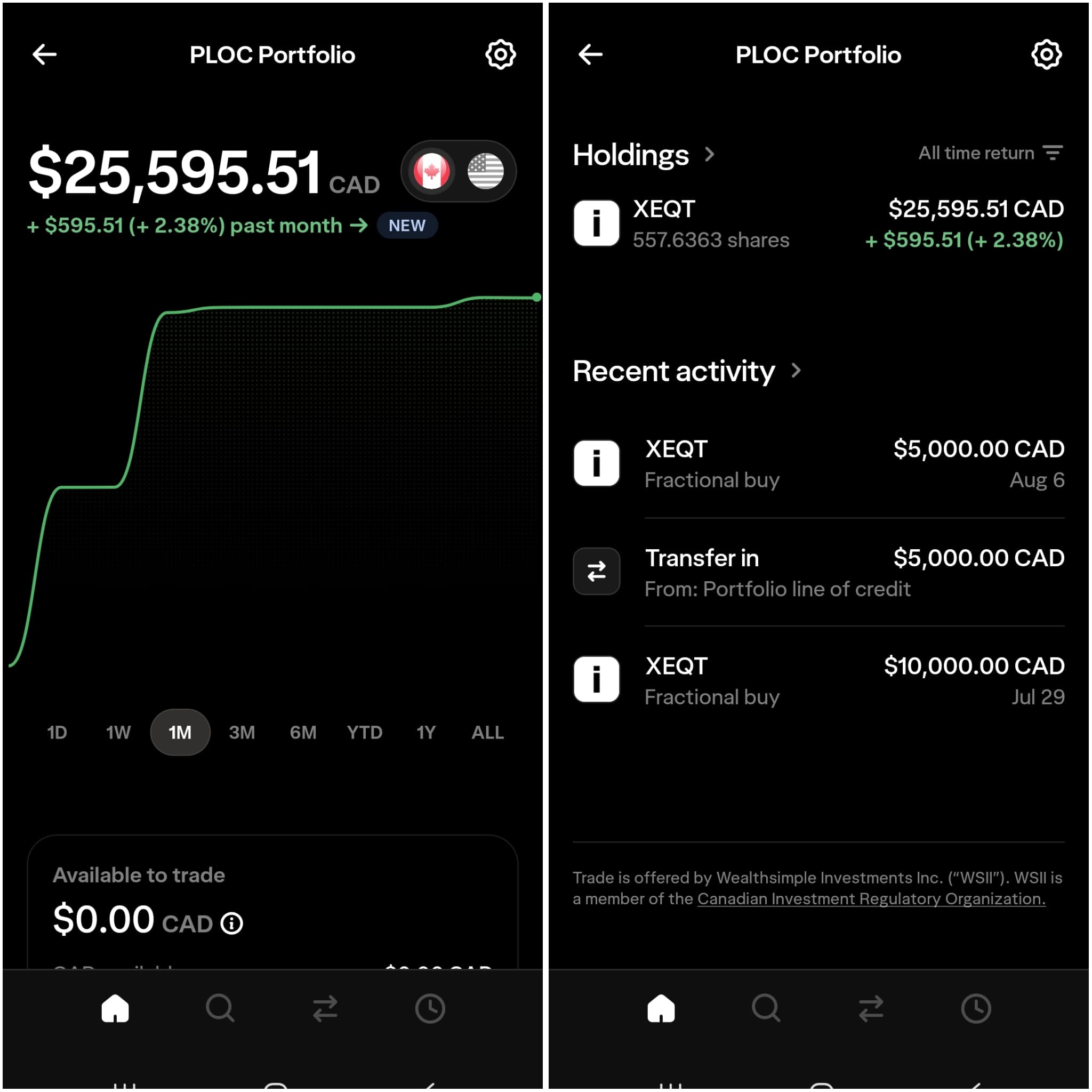
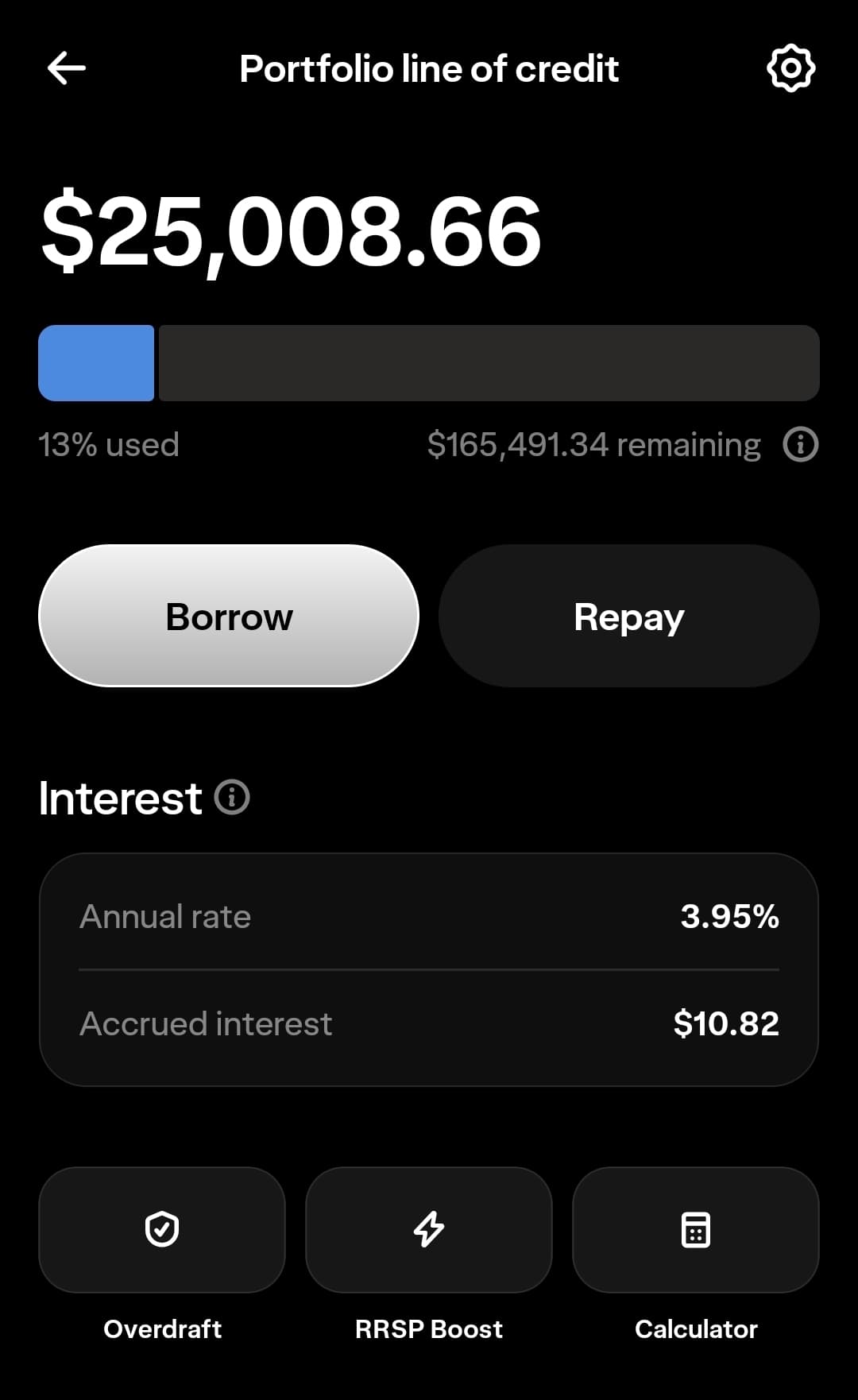
I started my Portfolio Line of Credit borrowing to invest through Wealthsimple on July 27, 2026. It would be with the intention of gradually borrowing more up to a maximum of $100K, to invest for at least 8-10 years unless something materially different happens which justifies ending the account earlier. So far, I have borrowed $25K and everything is invested in $XEQT. The borrowing rate is prime minus 0.50%, which is equal to 3.95% at the time of this post. My first interest charges deducted for borrowing from PLOC was $8.66 which is just added to my PLOC balance. 🟠 Updated: I will pay back ths interest monthly. (Thanks everyone who commented and shared your feedback on this topic 🙏🏻) Please note this PLOC borrowing to invest is separate from my Smith Manoeuvre portfolio. Also note borrowing to invest can be risky so please do your own dilligence and assess your own risk tolerance before implementing something similar. Anyone else who has a Portfolio Line lf Credit? What do you tend to invest in?
Feeling beyond grateful today. As you guys probably remember, about 2 months ago I lost my job and totaled my car in the same week. The bounce back since then has been incredible: Got engaged to the love of my life ❤️ Amazing family and friends Healthy An incredible community Portfolio at all-time highs 35K+ followers on X 12K+ followers on Threads 700+ subscribers on Substack Almost 2K followers on Blossom Seriously, thank you guys for all the support and for making so much of this possible. I’m just getting started. We’re just getting started. ❤️read more
It’s been a year since I shared our borrow to investment program with everyone so I think it time to revisit the total performance. The original purchases of our financial assets were in 2024 and tariff Mayhem in 2025 for $NVHE. If you made a decision just to purchase the assets alone without borrowing to invest, kudos to you for following! All purchases were opportunistic and bulk buys! 12 month stats: Both $LBS and $BK have split 3 times during the past 12 months increasing your total share count yield Vs YOC. $BANK has received two significant dividend increases, also increasing you yield Vs YOC. $NVHE has received one dividend increase during the past 12 months. Total return 96.6% Yield Vs YOC 14.42% Vs 23.44% My personal stats are much higher due to the time of purchase. I did mortgage my assets at 3/4 below prime with a current rate of 3.7% I recieve T5 and T3 eligible and capital gain dividends. Dividend tax credit and ROC. All my current ROC is used to service the loan principal and purchase $UTIL. My ACB is easy to follow as I do not not re-purchase the original assets. The eligible dividends service the loan interest. All interest is eligible for and added to line 22100 in your tax return, reducing your marginal tax rate. I personally do not advocate for others to borrow to invest. Everyone’s situation is different. My situation allows me to do so and will continue to benefit me for years to come. Original post is below. Always do your own research 🧐 and analysis 💹 https://link.blossomsocial.com/7uYa/97lj9r5mread more
@lecorb introduced the idea a few days back of actually reading your own portfolio and provided some structure and guidance for doing it. @etf.go has since walked through his portfolio as well (worth a read!). To be frank, I’ve never met either of these guys in person. From what I’ve gathered we’re around similar ages, but we’re on somewhat different paths. They’re both retired. I don’t really envision myself retiring. My career has evolved through frontline clinical work and leadership within a health authority, both of which I’ve genuinely enjoyed. Work is pretty embedded in who I am. It’s part of the package alongside family, athletics, coaching, investing and leisure. Maybe that changes someday. Life changes plans. But it highlights something important about investing: the portfolio has to fit the person, not the other way around. A couple people can be similar ages, understand investing equally well and still build very different portfolios because they’re solving different problems. I’ve learned a tremendous amount from both @lecorb & @etf.go. They’ve provided immense value to the Blossom community and have made me think more carefully about my own process. So this is my attempt at reading my own portfolio. And honestly, I think it’s an exceptional exercise even if the only thing you learn is: Does the portfolio I actually own line up with my risk tolerance, investing philosophy and the life I’m trying to live? Because it’s easy to accumulate investments over time and eventually end up with a collection of holdings rather than an actual portfolio. So I turned the exercise on mine. At first glance, around 20 positions mixing factor ETFs and individual companies might look scattered. But zoom out and I really see two parts: ETF Ladder + Conviction Companies. Despite looking different, the philosophy behind both is remarkably similar. I want profitable businesses, strong balance sheets, good capital allocation and valuations that make sense. The difference is how I get there. On one side, I trust systematic factor investing to do the screening. On the other, I do the work myself and concentrate when I think the opportunity warrants it. What am I trying to accomplish? I’m still accumulating across both registered and non-registered accounts, and I’m not building toward a particular retirement date. The objective is long term compounding without making the outcome overly dependent on my ability to pick stocks, predict markets or get the macro right. But I’m also not trying to simply own everything. I’m a factor investor first, and that forms the foundation of the portfolio. The ETF Ladder (60%) I don’t really think of my ETFs as “owning the market.” I’m deliberately tilting toward characteristics I actually want to own. Profitability is the thread running through the ladder. Then size and value. I want profitable companies across different market cap sizes, with additional emphasis on value as I move into smaller companies. Small companies aren’t automatically good investments because they’re small. Cheap companies aren’t automatically good investments because they’re cheap. And I don’t want struggling businesses simply to capture a theoretical factor premium. Companies need to be screened. That’s why I trust managers like Avantis and Dimensional to do much of that work for me. $CAGE, $DFAX, $CASV and $DFUS may look like separate ETFs, but I see them as different rungs of the same philosophy. Broad diversification is a benefit, but diversification isn’t the thesis. The thesis is profitability, size and value implemented systematically across thousands of companies. Small cap is where I’m particularly selective. If I’m accepting the additional risks that come with smaller companies, I want value and profitability working alongside size. I have little interest in owning small, expensive, unprofitable companies simply because an index tells me they’re part of “the market.” That’s also why I’m not completely comfortable relying on market cap weighting for the foundation of my portfolio. As a company’s market value grows, so does its weight. That can work extremely well, but it can also leave you increasingly exposed to companies carrying very rich valuations simply because they’ve become very large. I’m not anti market-cap. I just prefer a different set of rules. I want companies screened for characteristics I believe matter to long term expected returns, and I trust Avantis and Dimensional to implement that process more consistently across thousands of businesses than I ever could. I’m not choosing the individual companies. But I’m deliberately choosing what characteristics I want the companies I own to have. Conviction Companies (40%) This is where the implementation changes. Instead of outsourcing selection, I’m willing to do the work myself and concentrate when business quality, financial strength, valuation and long-term opportunity justify it. Conviction doesn’t mean liking a company. Every position has to earn its place through some combination of earnings quality, balance sheet strength, competitive advantage, capital allocation, free cash flow and valuation. I roughly see them as: Quality Compounders (17%) $MSFT, $GOOG, $MA, $TJX Durable moats, pricing power and strong economics. Generally the businesses I’m happy to let compound. Growth / Infrastructure Tech (8–9%) $ANET, $AMAT Networking and semiconductor infrastructure. Higher potential growth and volatility, so sizing matters. Defensive Infrastructure & Healthcare (10%) $FTS, $WCN, $MCK, $PBA Utilities, waste, healthcare distribution and midstream. Recurring demand and cash flows that don’t require everything economically to go right. Travel & Services (4%) $BKNG, $WSP Long term structural opportunities rather than short term macro trades. Resources / Precious Metals (1%) $WPM, $CCO Small and deliberate. Diversifiers rather than return drivers. Two methods. One philosophy. This might be the biggest thing I discovered doing the exercise. The ETF and individual company sides aren’t opposing strategies. The philosophy doesn’t change. The method of implementation does. With ETFs: I know the characteristics I want, but I trust a disciplined systematic process to find and weight thousands of companies displaying them. With individual stocks: I’ve done enough work on this particular business that I’m willing to make the selection myself and take concentrated risk. One is systematic conviction. The other is individual conviction. Both ultimately ask similar questions: Is the business profitable? Is the balance sheet sound? Does it allocate capital well? What am I paying for those economics? What return am I expecting for the risk? Risk: I don’t define risk simply as volatility. A stock falling 20% isn’t necessarily a problem if the underlying business and expected future return haven’t deteriorated. I’m more concerned about permanent impairment of capital, excessive concentration, weak balance sheets, paying valuations that require everything to go right, or constructing a portfolio dependent on one particular economic outcome. The ETF ladder diversifies company specific risk. Position sizing helps control the rest. And the combination lets me have conviction without requiring every conviction to be right. Conviction isn’t permanent: Owning individual companies means accepting that I can be wrong. A conviction position doesn’t get lifetime membership because I once liked the thesis. If the business deteriorates, capital allocation changes, the balance sheet weakens, the thesis breaks or valuation makes future returns difficult to justify, I’m willing to move on. Sometimes nothing is wrong with the company. The price simply stops making sense. A great business and a great investment aren’t always the same thing. Rebalancing: If a conviction company becomes too large, valuation gets stretched or I find a better opportunity, trimming can fund another idea or simply go back into the ETF ladder. Likewise, when markets fall, I don’t necessarily need to decide which individual company will recover fastest. I can add to the systematic side and let the factor process work. Rebalancing isn’t about constantly tinkering. But I will dial down risk or vice versa from time to time. It’s about preventing the risk attached to one idea from quietly becoming much larger than I intended. Does the portfolio actually look like me? That’s ultimately what I took from this exercise. I’m a factor investor first, but I love researching individual businesses. I believe deeply in diversification, but I’m comfortable with concentration when I’ve done the work. I want growth, but I care about the quality and price of the growth I’m buying. I accept volatility, but I don’t want unnecessary risk. And investing is part of my life. It isn’t the entire purpose of it. I don’t need a portfolio designed around escaping work as quickly as possible. I want one that compounds alongside a career, family, athletics, coaching, leisure and whatever else the next few decades bring. When I read the portfolio through that lens, the holdings don’t feel scattered at all. Maybe that’s the real value of this exercise. Don’t just ask: “What do I own?” Ask: “Why do I own it, what job is it doing, and does the portfolio I’ve built actually reflect the investor, and person I think I am?” Thanks to @lecorb and @etf.go for getting me thinking about this and for everything they’ve contributed here. I’d love to see more people do the same. As always, this is my process, not a template. Take what’s useful and leave the rest. read more
This post was inspired by @moementumfinance interview with @riggs about using Credit Cards to build wealth The "Free Equity" Engine: 2% Cash Back $FZROX Most people take their credit card cash back as a statement credit or spend it on coffee. Here is how to automate it into long-term equity growth for $0 out of pocket Here is the Set Up Put all recurring monthly expenses (utilities, groceries, insurance) on the Fidelity Rewards Visa (2% flat cash back). Set your rewards to auto-redeem directly into your brokerage or IRA. Set an auto-invest schedule to throw 100% of those rewards into $FZROX (Fidelity ZERO Total Market Index Fund). Why $FZROX Expense Ratio 0.00% (Zero management fees dragging down returns) Diversification Instant exposure to the entire US stock market The Math Breakdown 2% monthly cash back over 12 months = 24% of a single month's entire budget redirected into free equities every year. Compound that 24% annual spend recovery over decades inside a total market index fund, and you're building a secondary portfolio funded entirely by the credit card issuer's money. Zero fees. Zero manual effort. 100% self-funding portfolio growth. Are you auto-investing your credit card rewards, or using another cash-back strategy? Drop your setup below! 👇 read more
It’s become fashionable on social media to mock the “poor” financial decisions of strangers: the clothes, cars, and cottages that folks apparently can’t afford. At the same time, we love stories about the rich driving used vehicles or living in a modest home (No, Buffett’s house is not modest!). While the former can negatively affect the finances of an individual or family, I would argue that the latter, if practiced in greater numbers, would significantly disrupt the financial ecosystem that we all need to thrive in. In a healthy ecosystem in nature, top predators do not graze in the underbrush. Wolves hunt high-energy prey, leaving vegetation and low-energy prey to the creatures that rely on them for baseline survival. If the wolf went on a diet and started grazing on berries out of convenience, it would turn a forest into a barren wasteland. Our financial landscape mirrors this dynamic from nature: the top 20% of households account for roughly 60% of all consumer spending and hold over 70% of total wealth. When that massive purchasing engine shifts downstream, it carries enough force to reconfigure prices across baseline markets. This dynamic plays out across the most essential corners of everyday life. Thrift shops used to be community safety nets for working-class families. Social media has turned them into treasure hunts for affluent buyers and online resellers, pushing up prices and leaving some plus-sized clothes virtually unavailable. Remember when COVID crushed the supply of new cars and used car prices skyrocketed? Replace a supply shock with a demand shock of upper-middle-income buyers opting for cash-bought Corollas, and many working-class families would be priced out, leaving them to predatory auto loans or relying on public transportation. I think you get the point. We praise frugality universally, yet it can’t actually be practiced universally. The economy depends on higher-income folks buying more expensive stuff. For our family, staying in our lane looks like adopting a balanced hybrid approach, such as buying one new vehicle for primary family needs while keeping a practical used car strictly for daily commuting. For clothing, it means accepting hand-me-downs from friends and family or investing in durable, high-quality new pieces rather than raiding charity shop racks or fueling fast fashion. Dipping into the bottom tier of a market when you have the capacity for other choices is not grounded frugality; it reshapes supply for those with no alternatives.read more
Moneymaxxing: Using the viral trend to save, budget, build wealth https://www.cnbc.com/id/108344013?&view=story?__source=androidappshare I am not one for social media trends however I am sure the Blossom community can find this helpful with their personal finances. "J" AKA "icallbullshit"
Choosing the right platform can make a massive difference in your returns over time—especially when factoring in FX conversion rates, option fees, and trading tools. Here’s a breakdown of how Canada’s top 4 discount brokerages stack up: 🟢 1. Wealthsimple: Best for Passive Investors & CAD Stocks The Good: Zero-commission trading on Canadian stocks and ETFs, ultra-clean UI, automatic DRIP, fractional shares, and instant high-interest cash accounts. The Catch: 1.5% foreign exchange (FX) fee on U.S. trades unless you pay for a USD account plan. Basic charting tools and limited advanced order types. Best For: Buy-and-hold Canadian ETF/stock investors and beginners looking for simplicity. 🔵 2. Questrade: Best All-Rounder & Long-Term Wealth Building The Good: $0 commission stock/ETF trades, wide range of account types (TFSA, RRSP, FHSA, RESP, Corporate), and full support for Norbert’s Gambit for low-cost CAD/USD conversion. The Catch: Option contract costs add up ($0.99/contract) and the platform desktop setup is slightly more complex than modern fintech apps. Best For: Multi-account portfolio managers and long-term investors looking to hold USD assets without high conversion fees. 🟠 3. Moomoo Canada: Best for Active Traders & Low-Cost FX The Good: Free real-time Level 2 market data, robust technical charting, pre/post-market trading, very low options commissions ($0.65/contract), and ultra-competitive currency exchange fees (~0.09%). The Catch: Does not support fractional shares or registered accounts beyond basic TFSA/RRSPs. Best For: Active traders, swing traders, and options enthusiasts looking for institutional-style charting tools. 🟡 4. Webull Canada: Best for Mobile-First Technical Analysis The Good: Slick mobile app interface, low-cost options contracts ($0.99/contract), extended trading hours, and customizable stock screeners. The Catch: Charges a small flat trade commission on equities (~$2.99) unlike $0-commission competitors, and limited registered account support compared to legacy platforms. Best For: Active mobile traders who want technical indicators and screeners on the go. 💡 Quick Verdict Dipping your toes in or buying CAD ETFs? Go with Wealthsimple. Building a diversified USD/CAD portfolio with TFSA/FHSA/RRSP? Stick with Questrade. Trading U.S. options or active swing trading? Moomoo or Webull lead the pack on tools and pricing 💬 Which brokerage are you currently using, or are you considering making a switch? Drop your favorite platform in the comments! 👇 ⚖️ Affiliate Disclaimer: Full disclosure: Some links on tradecompare.ca are affiliate links. If you sign up or open an account through tradecompare.ca, I may receive a commission at no additional cost to you.read more
After few recent posts on Blossom on smith manoeuvre process or borrow to invest through PLOC (specially the recent post from @moementumfinance) I started looking into in and done some reading. Now I would like to dip my toe in PLOC or Margin Account. I dont have access to implement SM right now atleast next 3years as I am already in the mid of my mortgage term. So the closest I have access to PLOC or Margin. I am thinking to start very slow and little. I can think of below 2 approaches. But not sure which one to consider. Let me right down few parameters. I am keeping some number random for illustration only. Loan Amount:10000 Borrowing Rate:4% Marginal Tax Rate: 28-35% Year: min 10 Option 1: Invest in $ZEQT Either from PLOC or Margin Account Pay Back interest manually Turn On DRIP Option 2: Invest in $ZEQT-T Margin Account Turn OFF DRIP So Pay off Interest (4%) + 2% from Actual Loan automatically as Distributions from $ZEQT-T is almost 6% Now with 1 i will get the taste of DRIP and compounding interest over the time. Will pay off loan at the end and utilize capital gains. With option 2 as long as loan interest is less than 6% and Distributions is 6%. There is no manual intervention needed and it will auto pay interest+ principal. The downside is over the time tax benefit will reduce as total interest will reduce after paying principal. After 10 years I can keep it rolling or payoff the loan anytime during or after the tenure. But will lose biggest benefit of DRIP compounding. Any other drawback you are seeing on one option than other? Or anyother option combinations which have more benefits. Would like to hear back from @moementumfinance@karyungtom@cjs033@riggs who have already done this and have some insight of +- side effect. PS: I am not financial advisor. This is not a financial advice. Leverage play is very risky and have side effect. Do your own research and due diligence. read more
Still working through the QAFP estate material and posting the parts I think are useful. This one is niche, but it is the kind of mistake that only shows up after someone has died, when nobody can fix it anymore. Your RRSP, your TFSA and your life insurance usually do not pass through your will at all. Whoever you named on the account form gets that money directly. The will has no say, even if the will is newer and says something completely different. The tax bill does not travel with the money. When you die, your RRSP is treated as though it was fully cashed out on your final tax return. If you named one of your kids on that account, they receive the entire balance, and the tax gets charged to your estate, which means it comes out of whatever everyone else was going to inherit. Say you have a $200,000 RRSP with your oldest named on it, and your will splits everything else evenly between your three children. Your oldest receives the full $200,000. The tax owing on that RRSP is paid by the estate first, before the other two get anything, and depending on your province and your other income that year it can be a very large number. You thought you divided things evenly. You did not. Naming your spouse is the exception, and it is why most people never run into this. A registered account left to a spouse rolls over to them with no immediate tax, so nothing lands on the estate. A divorce does not automatically clear a designation you made during the marriage either. In most of the country the name on that form sits there until you go change it yourself. Quebec works differently, since designations on registered plans generally have to be made in a will there. It costs nothing to log in and look at who is actually named on your accounts. If your life has changed since you filled those forms out, and for most of us it has, that name might not be the one you would pick today. This pairs with the will post I put up a couple of days ago: one is the document being cancelled, this one is the money that never goes near the document. When did you last check who is named as the beneficiary on your accounts?read more
If you’re in Canada and thinking about using Wealthsimple’s Portfolio Line of Credit (PLOC), the key question isn’t “What has the highest return?” but “What can I hold without panicking if markets drop while I owe money?” Wealthsimple’s docs say you can borrow up to 35% of your investment value, at around prime ± 0.5% (roughly 3.95–4.95% recently), and your limit moves with the market. If your collateral falls too far, they can sell positions to restore the account. That’s why “safe” here really means low volatility, not “popular ETF.” 👉Where $XEQT Fits 📈 • XEQT is a globally diversified, all‑equity ETF with a medium risk rating and MER around 0.20%. • It’s safer than betting on a handful of single stocks, but BlackRock and multiple reviews are clear: it holds no bonds, can decline sharply, and is designed for long‑term growth, not short‑term stability. So: ✔ Great for 10–20+ years of unleveraged investing. ✖ Not great as the main asset backing a loan you might need to repay during a downturn. 💸Safer Options If You’re Borrowing 🛡 If you actually draw on a PLOC and want to keep risk low, safer categories are: 1. Cash-like / HISA ETFs • Aim to track cash or very short‑term deposits. • Price movement is minimal; the main risk is interest rate changes on yields. • Example tickers: Canadian HISA ETFs such as $CASH or $PSA. 2. Short-term bond ETFs • Hold government and high‑quality corporate bonds with near‑term maturities. • Less sensitive to rate changes than long bonds, and much less volatile than stocks. • Example: short‑term bond ETFs like $VSB 3. Balanced ETFs (stocks + bonds) • If you still want growth, a 40/60 or 60/40 balanced ETF is materially calmer than 100% equities. • These mix stocks with bonds, reducing drawdowns compared to all‑equity funds like $XEQT or $VEQT. Core idea: the more stocks you hold, the bumpier the ride. When debt is involved, that bumpiness can trigger margin calls at the worst possible time. 😃Simple PLOC Rules ✅ If you’re borrowing against a portfolio: • Keep your loan‑to‑value low. If Wealthsimple allows 35%, staying closer to 10–20% gives you more cushion. • Match the risk of the asset to the risk of the debt. The shorter and more certain your need, the more cash‑like your investment should be. • Avoid using a PLOC to chase hot themes or speculative names. Leverage magnifies both gains and losses. Bottom Line $XEQT is safer than picking random stocks, but it is still a stock fund first, safety net second. When there’s debt on the table, safety means lower‑volatility assets: cash‑like ETFs (CASH, PSA), short‑term bonds (VSB), or conservative balanced ETFs. The goal with a portfolio line of credit is simple: Don’t let your investments and your loan punch you in the face at the same time. 💥 read more
🎢As we enter the major earnings season in July, my portfolio has experienced extreme volatility with some major holdings experiencing daily price swings of more than 5%. It is during periods like this that a long-term investment approach becomes especially important, which will help investors take emotions out of the short-term price movements and focus instead on the long-term performance of the underlying businesses. The companies in my portfolio that have reported earnings so far are mostly showing steady growth in revenue and earnings, with some continuing to invest heavily in AI infrastructure to support future business expansions. I view this as a positive development and will discuss the details in the individual stock updates in the full post (see link in the comment). Software stocks experienced a moderate recovery in July which have helped increase my total portfolio value, but I believe my software stocks are still trading at levels far below their intrinsic values. I have continued to increase my positions in top quality holdings such as Constellation Software and Vitec Software to take advantage of these attractive valuations. Going forward as I enter the next stage of my FIRE plan, I will limit additional investments only to my registered accounts and the Smith Maneuver portfolio. All remaining excess cash flow will be redirected toward debt repayment, with the goal of reducing my fixed costs and strengthening my financial position. 📊 Here is a breakdown of my portfolio: TFSA: $193,013 -> $201,601 RRSP: $180,190 -> $194,231 ($5207 new contribution) Taxable: $582,439 -> $600,467 ---- Total: $955,642 -> $996,299 (excluding margin and options) You can find my full portfolio update using the link below, which includes additional information you may find interesting: - Updated DCF valuation based on latest earnings: $GOOGL$META$AMZN$MSCI$UNH$V$VIT.B - My Smith Maneuver Portfolio Update - All stock & option trades I made in the past month Here is the link to the full update in the pinned comment 👇read more
If you don’t like where you are financially, you’re allowed to change it. Not overnight. Not perfectly. And not by comparing your starting point to someone else’s. We all come to money from different places. Some people were taught about investing early. Some are figuring it out much later. Life happens, mistakes happen, and sometimes just getting through a difficult season takes priority. Your starting point doesn’t define where you can go from here. For me, that philosophy shows up in one very simple habit: I buy $XEQT every day. It’s not about trying to time the market or make one brilliant investment. It’s my way of consistently choosing the future I want to build, one small decision at a time. I can’t change the financial decisions I made years ago, and I don’t need to. I can learn from them and make different ones today. We don’t all start in the same place, and we won’t all follow the same path. But wherever you’re starting from, you still get to write what comes next. read more
Have you ever reached the end of the month and wondered, “How am I working this hard and still feel like I’m just trying to keep up?” If you’re working hard and still feel like you’re only surviving, this isn’t a post telling you to work harder. It’s a reminder that you’re not alone, and a place for us to share ideas that might help someone find a path forward. We spend a lot of time discussing investing, portfolios, and net worth in this community, and those conversations have real value. But it’s also worth remembering that many Canadians are working just as hard simply to pay rent, buy groceries, and keep the lights on. That doesn’t mean they’ve failed. It means the math has become much harder for many households. Financial success isn’t just about investing well, it’s also about having access to work that provides a livable income. For someone starting over, changing careers, or entering the workforce, these aren’t easy jobs, but they are realistic paths that many Canadians have used to build stable, well-paying careers without a four-year university degree: • Powerline Technician (Lineman) • HVAC Technician • Industrial Electrician • Elevator Mechanic • Millwright (Industrial Mechanic) • Pipefitter / Steamfitter • Heavy Equipment Technician • Heavy Equipment Operator • Crane Operator • Welder (especially industrial or specialty welding) • Plumber • Railroad Conductor • Police Officer • Firefighter • Long-haul Truck Driver • Mining and Oil & Gas careers Many of these careers offer paid apprenticeships, on-the-job training, or shorter certification programs. They can provide a path toward financial security, and for many, eventually six-figure incomes. But income is only one piece of the puzzle. I’d love to hear from you 🙏🏻 If you’ve found something that’s helped, whether it’s a career change, learning a trade, moving to a different province, starting a business, budgeting differently, investing consistently, or something else entirely, please share it. And if you’re still struggling, what’s the biggest obstacle you’re facing right now? Let’s make this a thread that’s less about comparing net worths and more about sharing ideas, opportunities, and hope. Someone reading these comments today may be exactly where you were a few years ago. Sometimes hope doesn’t come from a headline, it comes from a stranger saying, “Here’s what worked for me.” read more